How to Start Dropshipping in South Africa with No Money
You can start dropshipping in South Africa with almost no money, but not with literally none. The model removes the biggest cost of retail, which is buying stock, because your customer pays you before you pay the supplier. What you still need is a small amount for a platform, one or two product samples and a lot of your own time for marketing. With free trials, free tools and organic content, a lean start can cost a few hundred rand rather than a few thousand.
This post shows exactly what you can get for free, which costs you cannot avoid and a step-by-step plan for launching on a shoestring. For the full picture of how the model works locally, from suppliers to tax, read our complete guide to dropshipping in South Africa.
Can you really start dropshipping with no money?
You can start dropshipping without buying stock, but you will still spend a small amount before your first sale. The honest answer is "very little money" rather than "no money". The people who claim a true R0 start usually leave out samples, a payment gateway or the time it takes to build traffic without ads.
What makes dropshipping cheap is the order of payments. A customer buys from your store, the money lands in your payment gateway and you then pay the supplier's wholesale price. You never hold unsold stock. The catch is that the time and effort you would have spent on stock now goes into marketing, because nobody finds a new store on their own.
What you can get for free (or nearly free)
Most of the tools you need to launch have a free tier or a trial. Used well, they let you build and test a store before you commit real money.
Your store platform
As of November 2026, Shopify's South African pricing page offers three days free, then US$1 a month for your first three months. After that, the Basic plan is US$25 a month, or US$19 a month on annual billing. Shopify also gives you a free address ending in myshopify.com, so you do not need to buy a domain on day one. It also includes free themes, which are good enough to launch with.
WooCommerce is a free plugin, but it needs WordPress hosting, which you pay for. It suits people who already have hosting or are comfortable managing a website. Our guide on how to set up a WooCommerce store in South Africa explains the setup.
Taking payments
Local payment gateways do not usually charge you to sign up. Payfast's fees page lists no setup or monthly fees. You pay per transaction instead: 3.2% + R2 for card payments and 2% (minimum R2) for Instant EFT, excluding VAT. That means payment costs only arrive once you are making sales.
Marketing and content
TikTok, Instagram, Facebook and WhatsApp are free to use. A phone camera, free editing apps and honest product demonstrations are enough to start. Free AI tools can help you draft product descriptions and video scripts, as long as you edit them with your own knowledge of the product.
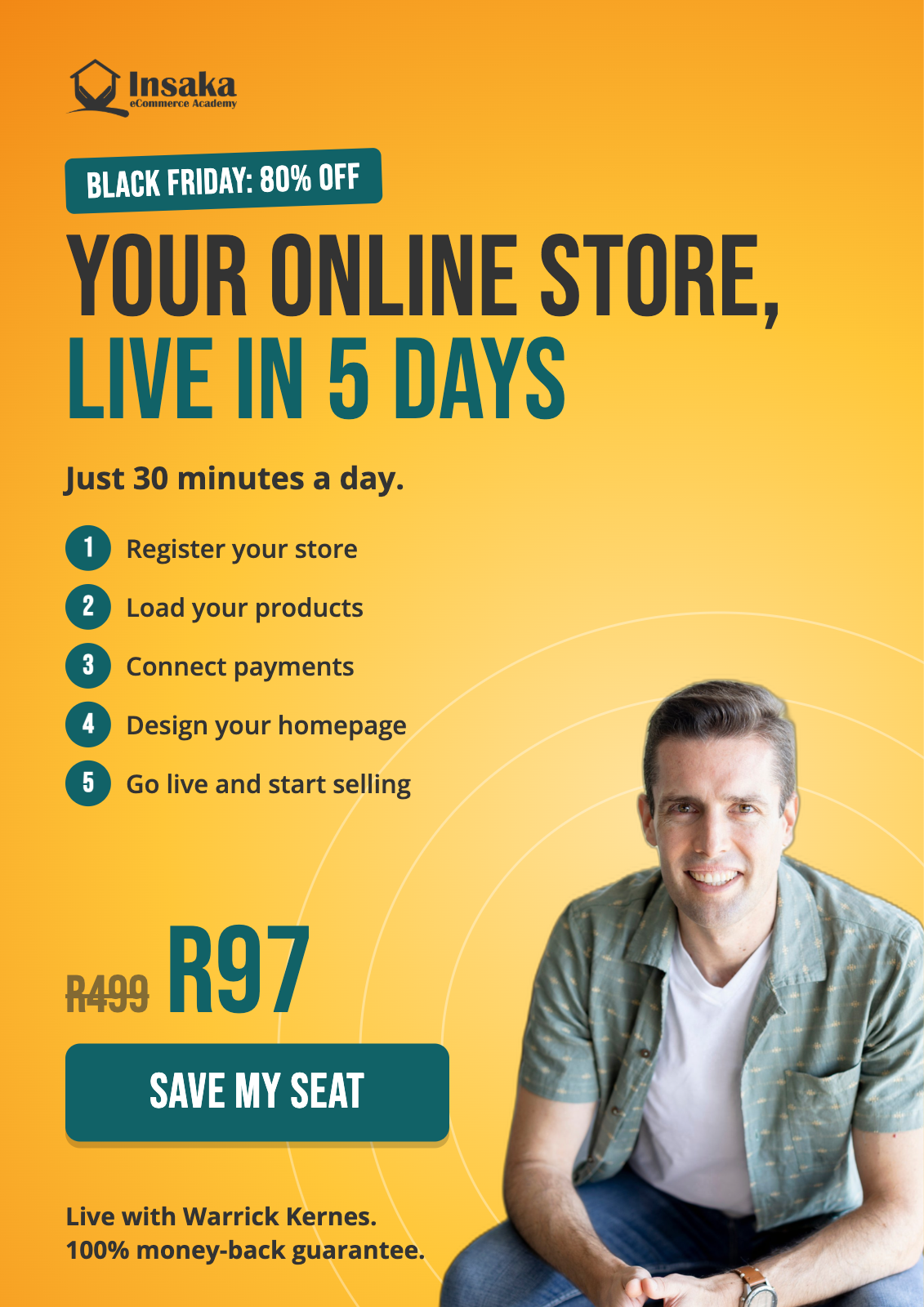
5-Day Workshop · Starts Monday 16 November
Use your free trial well by building with live guidance
In the live 5-Day Workshop with Warrick Kernes you register your store on Day 1 and go live on Day 5, in about 30 minutes a day. It costs R97.
The costs you cannot avoid
A few costs are unavoidable if you want a store that customers trust. Plan for them from the start so they do not surprise you once the free trial ends.
- Platform fees after the trial. Your platform becomes a monthly cost once introductory pricing ends. Price it in US dollars if you use Shopify, because the rand cost moves with the exchange rate.
- Third-party payment fees on Shopify. If you use a local gateway such as Payfast instead of Shopify's own payments, Shopify charges an extra 2% on the Basic plan, according to its pricing page.
- Product samples. Order at least one sample of your main product. You need it to check quality, take your own photos and see how long delivery really takes.
- A domain name, eventually. A .co.za address builds trust and is worth buying once you start getting sales.
- Your time. Without an ad budget, content and outreach replace paid traffic. Expect to spend time every day on this.
A lean launch budget for dropshipping in South Africa
The table below shows where money goes in a low-budget launch and how to keep each item close to zero. Prices are from the providers' own pages, checked in November 2026.
| Item | Lean option | Cost at launch |
|---|---|---|
| Store platform | Shopify trial and introductory offer | 3 days free, then US$1 a month for 3 months |
| Theme | Free Shopify theme | R0 |
| Payment gateway | Payfast, pay per transaction | R0 until you make a sale |
| Domain | Free myshopify.com address at first | R0, buy a .co.za later |
| Samples | One or two hero products only | Supplier's wholesale price |
| Marketing | Organic video, WhatsApp, your network | R0, but daily time |
Your real starting cost is mostly your samples. That is why choosing one focused product range matters so much on a tight budget. Ten random products mean ten samples, while one niche with two hero products keeps costs down and makes marketing easier.
How to start dropshipping with no money: step by step
A no-money start works when you spend time where others spend cash. Follow these steps in order and you can launch without risking more than the cost of a sample.
- Pick a narrow niche. Choose a group of customers you understand, such as dog owners or home bakers. A focused store needs fewer samples and is easier to promote for free.
- Find a local supplier who will dropship. Local suppliers deliver in days and make returns simpler. Our guide to dropshipping suppliers in South Africa explains how to find and vet them.
- Do the maths before you spend anything. Work out your profit per order after the supplier price, delivery and payment fees. Our post on whether dropshipping is profitable in South Africa shows how to calculate this.
- Order one sample. Use it to check quality, film content and test the supplier's delivery speed.
- Build the store during your free trial. Prepare your product photos, descriptions and policies before you start the trial, so the free days go on building, not planning.
- Set up payments and a test order. Connect your gateway, place a small test order and check that the supplier receives it correctly.
- Launch with free marketing. Post product videos daily, tell your own network and reply to every message quickly.
- Reinvest your first profits. Use early profit for a domain, more samples and later a small ad test, rather than spending ahead of sales.
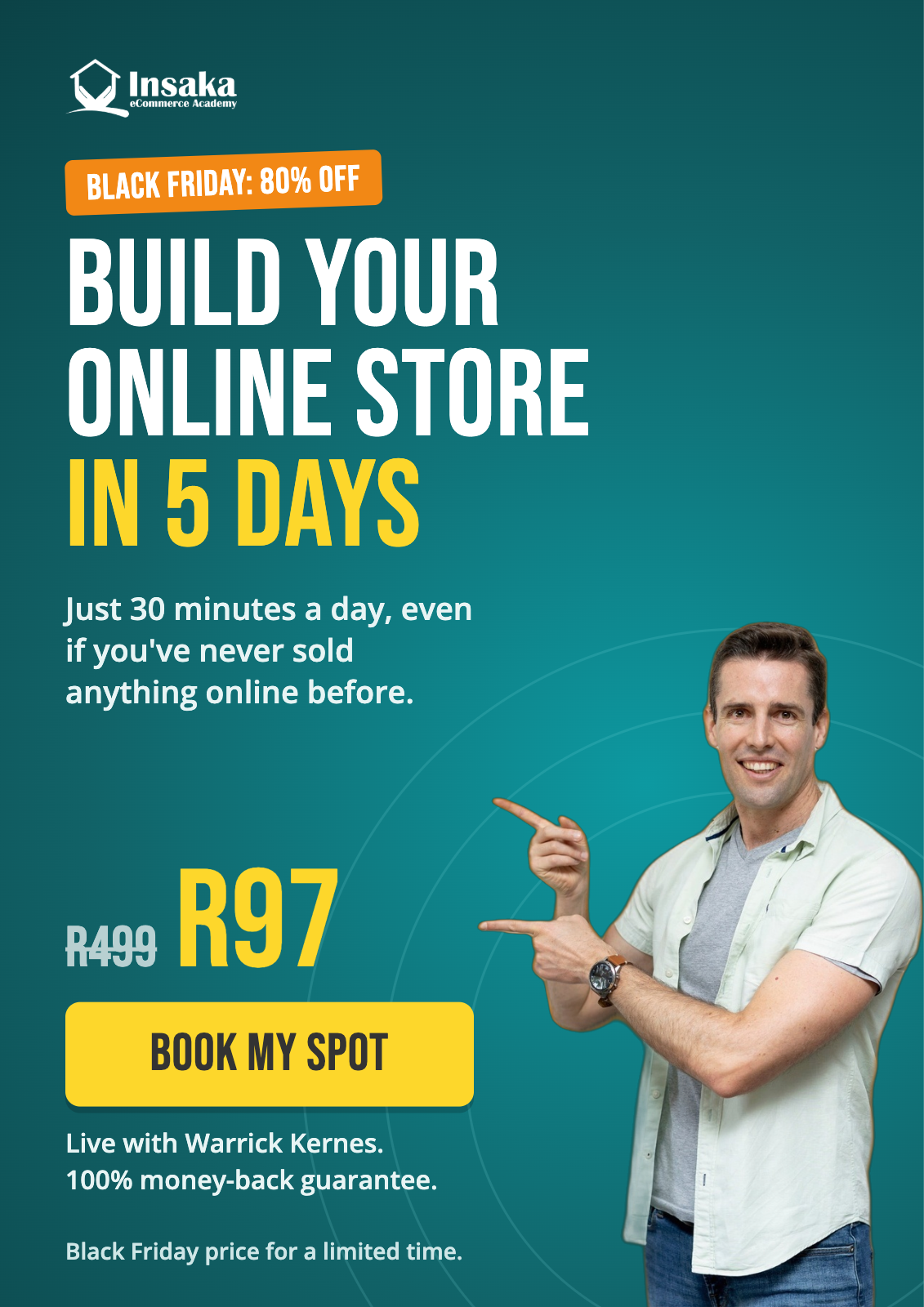
5-Day Workshop · Starts Monday 16 November
Turn these steps into a live store in five days
Load products on Day 2 with access to Insaka's AI product research tool, then connect EFT payments on Day 3. The workshop starts Monday 16 November and you need no experience.
Free ways to get your first dropshipping sales
Without an ad budget, your first sales come from content, conversations and people who already know you. These channels cost nothing but take consistent effort.
Short-form video
Show the product being used, solve a problem on camera and answer common questions. Real footage from your sample beats supplier photos every time. Our guide on how to sell on TikTok in South Africa covers what works locally.
WhatsApp and your own network
Friends, family, colleagues and community groups are often your first customers. A WhatsApp Business catalogue and status updates let you share products without spending on ads. See how to sell on WhatsApp in South Africa.
Helpful product pages
Clear, original product descriptions with sizes, materials and delivery times help you appear in Google and in AI search tools over time. Copying the supplier's text gives Google and shoppers no reason to pick your store.
Cash flow risks to watch on a tight budget
The biggest risk of a no-money start is not the setup cost. It is running out of cash between taking an order and getting paid. Plan for these situations before they happen.
- Payout timing. Your gateway holds your money until it pays out. Payfast lists a standard payout fee of R8.70 and an immediate payout option at 0.8% (minimum R14), both excluding VAT. Know how quickly you can access funds before you promise suppliers payment.
- Supplier payment terms. Some suppliers want payment before they dispatch, which is fine if your gateway pays out quickly. Agree terms upfront.
- Refunds and returns. Under South African consumer law, you owe the customer a refund for valid returns even if your supplier delays crediting you. Keep a small buffer for this.
- The end of introductory pricing. Put a reminder in your calendar for when your platform moves to full price.
Avoid paid apps and premium themes until you have regular sales. Our list of the best dropshipping apps for Shopify in South Africa compares the main options.
5-Day Workshop · Starts Monday 16 November
Get your questions answered live as you build
The workshop includes daily live Q&A calls with Warrick, support in the VIP Facebook group and lifetime access to the replays, all for R97.
Frequently asked questions
Can I start dropshipping with R0 in South Africa?
Not quite. Free trials, free themes and organic marketing can keep your costs very low, but you will usually pay for a sample and for your platform once the trial ends. Budget a few hundred rand rather than nothing.
Is dropshipping free on Shopify?
No, but it starts cheaply. Shopify's South African pricing page lists three free days, then US$1 a month for three months, before the Basic plan at US$25 a month. Keep app spending low until you are making regular sales.
Do I need to register a business to start dropshipping?
You can start as a sole proprietor and declare your profit on your personal tax return. Many sellers register a company later as the business grows. Some suppliers and gateways prefer a registered business, so check their requirements first.
Start lean, then grow with Insaka
Starting with no money is about spending time and attention instead of cash, then reinvesting your first profits wisely. Insaka eCommerce Academy helps South Africans build online stores using local suppliers, local payment options and local marketing. For a broader view of low-cost options beyond dropshipping, read how to start an online business for almost free in South Africa.
When you are ready for structured, step-by-step help, explore Insaka's courses and resources at insaka.co.za.
Written or reviewed by Warrick Kernes, founder of Insaka eCommerce Academy and Shopify's 2021 Top Education Partner worldwide, based on 15+ years of selling online in South Africa.